A cap is only as good as what it is made from. Two caps can look identical on a product photo, yet one holds its shape after a year of daily wear while the other sags, fades, and frays within a few months. The difference almost always comes down to fabric, structure, and stitching.
If you are sourcing custom baseball caps for a team, a company, a festival stall, or a retail line, understanding the materials behind the product helps you order with confidence instead of guesswork.
This guide walks through every material that goes into a baseball cap, the crown fabric, the brim core, the closure, the sweatband, and the thread, so you know exactly what to ask for when you request a quote.
Whether you are comparing cotton twill against polyester or trying to decide if wool blend is worth the extra cost, you will find the practical detail you need to choose high-quality custom baseball caps that suit your budget, climate, and brand image.
Why Material Choice Matters for High-Quality Custom Baseball Caps
The fabric of a cap affects four things that customers notice immediately: how it feels against the skin, how well it keeps its shape, how it performs in different weather, and how sharp your logo looks once it is stitched or printed on.
A stiff cotton twill panel holds embroidery beautifully, while a soft brushed cotton feels broken in from day one but shows stitching differently. Getting this decision right at the sourcing stage saves reprints, returns, and disappointed teams further down the line.
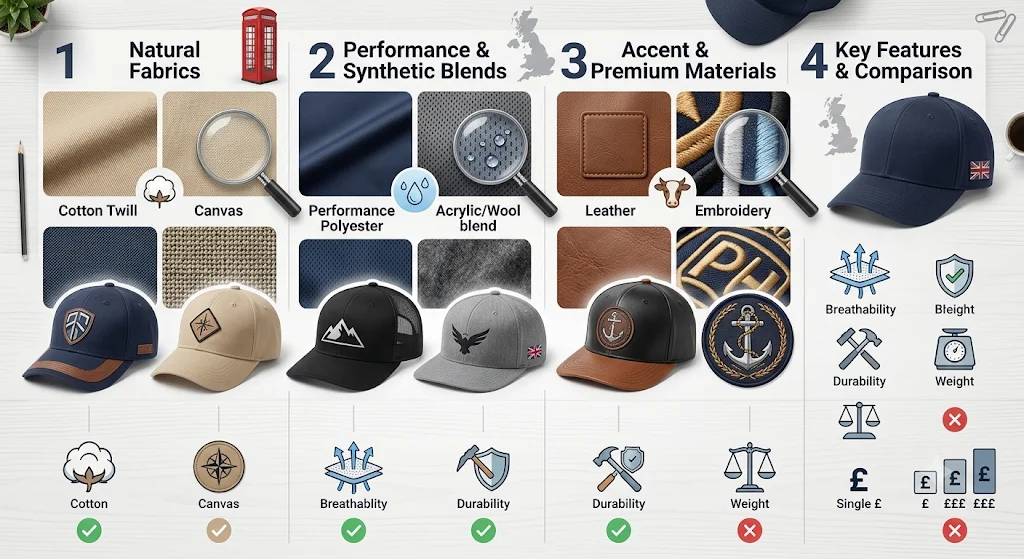
Below is a breakdown of the main fabrics used across crowns, panels, brims, and closures, along with where each one performs best.
Cotton Twill: The Industry Standard
Cotton twill is the most widely used fabric in the cap industry, and for good reason. It has a diagonal weave that gives it structure without stiffness, it takes embroidery cleanly, and it softens gradually with wash and wear rather than losing shape. Most six-panel structured caps you see on sports teams and corporate orders are built on a cotton twill base.
Cotton twill comes in a few weights. Heavier twill (around 8 to 10 ounces) suits structured, front-facing panels because it holds a crisp silhouette, while lighter twill is often blended into the side and back panels for comfort. It breathes reasonably well, is easy to dye consistently, and remains one of the most cost-effective choices for bulk orders.
Chino Twill: A Softer Cotton Alternative
Chino twill is a lighter, more relaxed cousin of standard cotton twill. It has a softer hand feel and a slightly more casual look, which makes it popular for dad caps and unstructured styles. Because it is thinner, it drapes rather than holds a rigid shape, and it is often chosen for caps that are meant to look pre-washed or vintage from the first wear.
Wool and Wool Blends
Wool and wool acrylic blends are the premium end of cap fabrics. They have a fine, slightly textured surface, they resist wrinkling, and they hold colour with a depth that cotton cannot quite match. Wool blend caps are common in premium fashion collections, golf clubs, and structured fitted caps that need a tailored, close-to-the-head fit.
The trade-off is cost and climate suitability. Wool blends run warmer than cotton, so they suit autumn and winter ranges better than a summer festival order. They also cost more per unit, which is worth factoring into your budget if you are ordering at scale.
Polyester and Polyester Blends
Polyester is valued for its durability and colour retention. It resists fading in direct sunlight far better than cotton, dries quickly if it gets wet, and holds its shape even after repeated washing. Pure polyester or cotton-polyester blends are common in sports and performance caps because the synthetic fibre wicks moisture away from the scalp during activity.
The main drawback is breathability. On its own, polyester traps more heat than cotton, so many manufacturers blend it with cotton (commonly a 65/35 or 60/40 split) to balance durability with comfort. If your caps are aimed at outdoor sports, running clubs, or golf societies, a poly-cotton blend is usually the smarter choice over pure cotton.
Mesh Panels for Trucker-Style Baseball Caps
Mesh backing is the defining feature of trucker caps, and it exists purely for ventilation. The open-weave polyester or nylon mesh on the back panels lets air circulate around the head, which matters for anyone wearing the cap for long stretches outdoors, on a job site, or at a summer event. The front panels on a trucker-style cap are usually still cotton twill or foam-backed fabric, giving you a structured logo area combined with a breathable back.
Mesh does have a shorter lifespan under heavy stretching than woven fabric, so it works best on adjustable snap-back or buckle closures rather than fitted styles.
Brushed Cotton and Soft-Touch Fabrics
Brushed cotton goes through a finishing process that raises the surface fibres slightly, giving the fabric a soft, almost suede-like texture. It is a popular choice for low-profile, relaxed caps aimed at streetwear or lifestyle branding, since the fabric already feels worn in straight out of the box. It embroiders well, though very fine detail can lose some sharpness compared to a tighter cotton twill weave.
Nylon and Performance Synthetics
Nylon and other technical synthetics appear mostly in performance and outdoor caps. They are lightweight, water-resistant, and quick-drying, which suits running, cycling, hiking, and fishing gear. Some performance caps blend a small percentage of spandex or elastane into the crown for stretch-fit styles that skip an adjustable closure entirely.
Leather and Faux Leather Accents
Leather rarely covers a whole cap, but it shows up frequently on the strap-back closure at the rear. A genuine or faux leather strap with a brass buckle gives a cap a premium, slightly rugged finish that pairs well with heritage or outdoor-style branding. It is more expensive than a plastic snap closure and needs slightly more care to avoid cracking over time, but it is a popular upgrade for limited-edition or premium retail runs.
Cap Material Comparison Table
Use this table as a quick reference when briefing your supplier or comparing quotes for high-quality custom baseball caps.
| Material | Best For | Breathability | Durability | Relative Cost |
|---|---|---|---|---|
| Cotton Twill | Structured, everyday branded caps | Moderate | High | Low to Medium |
| Chino Twill | Casual, unstructured dad caps | Moderate | Medium | Low |
| Wool Blend | Premium, cold-weather, fashion caps | Low | High | High |
| Polyester / Poly-Cotton | Sports, outdoor, high-wash use | Low to Moderate | Very High | Low to Medium |
| Mesh (Trucker Back) | Hot weather, all-day outdoor wear | Very High | Medium | Low |
| Brushed Cotton | Streetwear, relaxed lifestyle branding | Moderate | Medium | Medium |
| Nylon / Performance | Running, cycling, technical sportswear | High | High | Medium to High |
| Leather / Faux Leather | Premium strap-back closures | Low | Medium to High | Medium to High |
Crown, Brim, and Closure Materials
Brim Core: Cardboard vs Plastic
Underneath the fabric of the brim sits a stiffening core, usually either pressed cardboard or a plastic sheet. Cardboard is cheaper and lighter, but it loses shape if it gets wet and eventually curls with humidity. A plastic core costs a little more but holds a flat or curved brim shape through washing and rain, which is why most mid-range and premium caps use it as standard.
Buckram and Structured Crowns
Structured caps rely on a stiff interior layer called buckram, sewn between the outer fabric and the lining. It gives the front panels their upright, rounded shape. Unstructured caps skip buckram entirely, letting the fabric fold naturally to the head, which is why unstructured styles feel more relaxed straight out of the box.
Closures: Snapback, Buckle, Velcro, and Fitted
The closure at the back determines both fit and material choice. Plastic snap closures are the most common and budget-friendly, adjustable buckle straps (fabric, leather, or faux leather) offer a more premium finish, and hook-and-loop (velcro) closures are practical for caps that see frequent size adjustment.
Snapback caps typically use a moulded plastic tab, while a genuinely fitted style has no back closure at all, relying on stretch-woven fabric or an exact size match instead.
Thread, Stitching, and Eyelet Materials
The thread used for embroidery matters almost as much as the cap fabric itself. Polyester thread is the industry default because it resists fading and holds tension well through dense stitching. Rayon thread gives a slightly glossier finish but is less colourfast, and metallic thread is reserved for accent details because it is more fragile under repeated washing.
If you want to compare how custom embroidered caps hold detail against printed alternatives, the comparison between embroidered and printed caps explains how thread density and stitch count change the finished look on different fabrics.
Eyelets, the small metal or fabric-wrapped holes near the crown, are there for ventilation. Metal eyelets last longer and suit structured caps, while fabric-bound eyelets sit flush against softer, unstructured fabrics for a cleaner look.
How to Choose the Right Material for Your Brand
Before ordering UK custom embroidered caps you should think how the cap will actually be worn. A corporate gift that sits in an office drawer most of the year has very different requirements to a cap worn daily on a building site or at outdoor sports training. Match the fabric to the use case first, then layer in budget and branding preferences.
- Everyday corporate or retail branding: cotton twill offers the best balance of price, structure, and embroidery clarity.
- Outdoor sports, running clubs, or hot-weather events: choose poly-cotton blends or mesh-back styles for breathability.
- Premium retail, golf, or fashion collections: wool blend fabric with a leather strap closure signals quality.
- Streetwear or casual lifestyle brands: brushed cotton or chino twill in an unstructured build feels right off the shelf.
- Large teams needing consistent sizing: consider military caps style cotton builds, which are cut for durability across mixed head sizes.
Sustainable and Eco-Friendly Cap Materials
Demand for recycled and organic materials has grown steadily across UK headwear buyers. Recycled polyester, made from post-consumer plastic bottles, performs almost identically to virgin polyester in durability and colour retention, while organic cotton twill offers the same structure as standard cotton with a lower environmental footprint during growing and processing.
If sustainability messaging matters to your brand, ask your supplier directly whether recycled or organic options are available for your chosen style, since not every fabric weight comes in an eco version by default.
Frequently Asked Questions
What is the most durable material for custom baseball caps?
Polyester and poly-cotton blends are generally the most durable, resisting fading, shrinking, and shape loss through repeated washing better than pure cotton.
Which fabric is best for hot weather and outdoor events?
A mesh-back trucker style or a lightweight poly-cotton blend performs best in heat, since both allow airflow and dry quickly if they get wet.
Is cotton twill or polyester better for embroidered logos?
Cotton twill is usually preferred for embroidery because its firm, structured weave holds fine stitch detail more cleanly than softer synthetic fabrics.
Why do some baseball caps feel stiffer than others?
Stiffness comes from the buckram layer inside structured crowns and the core material in the brim. Unstructured caps skip buckram, so they sit softer and fold naturally.
Are wool baseball caps only suitable for winter?
Wool blend caps run warmer than cotton, so they are best suited to autumn and winter ranges, though lightweight wool blends can still work for cooler summer evenings.
What material should I choose for a large team order on a budget?
Standard cotton twill offers the best balance of low cost, consistent quality, and clean embroidery for bulk team or corporate orders.
Do eco-friendly cap materials cost more?
Recycled polyester and organic cotton typically carry a modest price premium over standard fabric, though the gap has narrowed as demand for sustainable headwear has increased.
Choosing Materials for a Cap That Lasts
The best material for your next order depends on where the cap will be worn, how often, and what impression you want it to leave. Cotton twill remains the reliable, cost-effective default for most branded orders, poly-cotton blends and mesh backs suit anything active or outdoor, and wool blends elevate a cap into premium territory.
Whichever direction fits your brand, getting the fabric right from the start is what separates a cap people wear once from high-quality custom baseball caps people reach for every day.
Ready to put these materials to work on your own design? Explore the full custom caps range or get in touch with the Caps Maker UK team for a fabric recommendation tailored to your order size and budget.
