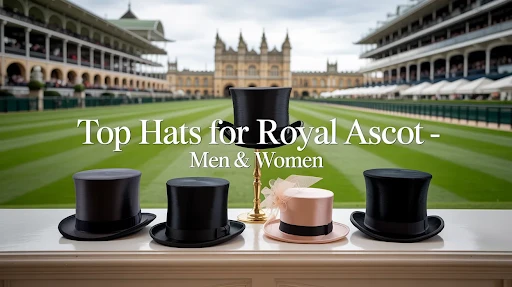
Imagine the gates of Ascot Racecourse swinging open on a warm June morning. Ahead of you stretches a shimmering canvas of silk top hats catching the light, sculpted melusine crowns gliding above morning coats, and a breathtaking gallery of wide-brim masterpieces in every shade from champagne to cobalt. Royal Ascot is not merely a horse race, it is the world’s most spectacular celebration of hat culture, where headwear is the main event.
Whether you are a first-time guest trying to navigate the dress code or a seasoned racegoer hunting for a vintage silk top hat in a rare size, this guide has you covered from crown to brim. Royal Ascot 2026 runs from 16–20 June, and whether you are searching for the perfect Ascot top hat for men or the most striking Ascot hat for women, this is the only guide you need.
We cover every enclosure’s rules, the full top hat hierarchy, the best women’s styles by face shape, buying versus hiring, vintage silk care, and a comprehensive FAQ, all structured so you can find exactly what you need, fast.
Understanding the Royal Ascot Dress Code by Enclosure
Before you spend a single pound on any hat, you need to know which rules apply to you. Royal Ascot is divided into four distinct enclosures, each with its own dress code. Getting this wrong is not just embarrassing, in the Royal Enclosure, you can be turned away at the gate.
Royal Enclosure, The Strictest Rules
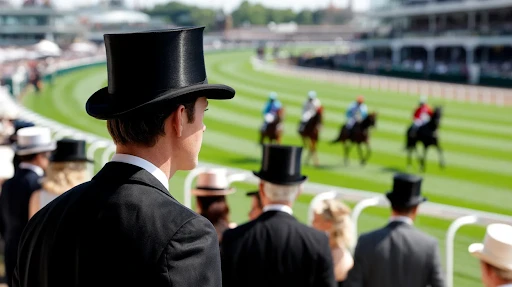
The Royal Enclosure operates the most rigorous dress code in British racing. For men, a black or grey top hat is mandatory and must be worn at all times while in the enclosure (exceptions apply only in restaurants, private boxes, and enclosed seating areas). Formal morning dress, a morning coat with matching striped trousers, is required. There is no room for interpretation here.
For women, the rules are equally precise. A hat or headpiece with a solid base of at least 4 inches (10cm) in diameter is required. Fascinators are explicitly prohibited, as are decorative headbands used as a substitute for a proper hat. The hat must sit on the head, not be pinned to the hair at an angle without structural support.
Queen Anne Enclosure
The Queen Anne Enclosure is the most popular and slightly more relaxed. For men, a hat is recommended but not mandatory; however, a matching full-length suit is compulsory (no odd trousers). For women, a hat, headpiece, or fascinator is required, but there is no minimum diameter restriction, giving significantly more creative freedom.
Windsor & Village Enclosures
These two enclosures operate under smart daywear guidelines. Hats are encouraged but not enforced by strict rules, and fascinators are fully accepted. These enclosures are ideal for guests who want to enjoy the occasion’s atmosphere without the formality of the Royal or Queen Anne Enclosures.
Quick-Reference Enclosure Comparison
| Enclosure | Men’s Hat Rule | Women’s Hat Rule | Fascinators Allowed? |
| Royal Enclosure | Top hat mandatory (black or grey) | Solid base, min. 4 inches (10cm) | No |
| Queen Anne | Recommended, not required | Hat or fascinator required | Yes |
| Windsor | Encouraged, not required | Encouraged | Yes |
| Village | Encouraged, not required | Encouraged | Yes |
Best Ascot Hats for Men, The Top Hat Breakdown
For men attending the Royal Enclosure, the top hat is not optional, it is the centrepiece of the entire outfit. But not all top hats are created equal, and understanding the hierarchy will help you make the right investment.
The History of the Silk Top Hat, And Why It Disappeared
The silk plush top hat has a lineage stretching back to 1793, when it is believed to have first appeared in England. For nearly two centuries, it reigned as the supreme expression of British formal dress, worn at royal occasions, race meetings, weddings, and parliamentary openings.
What made the silk top hat extraordinary was its material: a unique long-napped silk plush woven with a distinctive pile that created an almost liquid shine when brushed in a single direction. Lighter than felt, more luminous than any alternative, and incomparably refined, a well-maintained silk top hat is arguably the finest article of men’s formal wear ever produced.
The story ends in the 1960s, when the last manufacturing facility producing silk plush fabric closed its doors. No new silk top hats have been made since. Every genuine silk top hat in existence today is a vintage or antique piece, and the supply shrinks with each passing decade. Rarity drives value considerably, and larger hat sizes are especially scarce, since human head sizes have grown over generations, meaning fewer vintage pieces fit modern wearers without professional conforming.
Types of Top Hats for Royal Ascot: A Material Comparison
| Type | Material | Finish | Price Range | Best For |
| Vintage/Antique Silk | Original silk plush | High-gloss shine | £300–£1,500+ | Ultimate formality, collectors |
| Melusine | Long-haired fur felt | Polished, near-silk shine | £150–£400 | Best modern alternative |
| Fur Felt | 100% fur felt | Matte/semi-gloss | £100–£250 | Durability, value |
| Wool Felt | Wool | Matte | £50–£150 | Budget/hire alternative |
For anyone attending the Royal Enclosure who wants the closest possible experience to a silk top hat without hunting the antique market, melusine fur felt is universally regarded as the finest modern option. Its long-haired surface creates a polished sheen that photographs beautifully and holds its shape through a long race day.
For race day if you are attending in the Village enclosure we recommend a more casual approach and suggest you take a look at our custom baseball cap services.
Black Ascot Hat vs. Grey, Which Should You Choose?
Historically, grey was the traditional colour for Royal Ascot’s top hat, it is even embedded in the name of Lock & Co.’s famous “Ascot” style. However, black has become dominant in practice for one simple reason: the vast majority of surviving vintage silk top hats are black, and as silk became the gold standard, black became the norm.
Both colours are fully permitted in the Royal Enclosure. The practical rule is straightforward:
- Wearing a grey morning suit? A grey top hat creates perfect tonal harmony.
- Wearing a black or charcoal morning suit? A black top hat is the natural choice.
- Melusine hats are most commonly available and recommended in black.
- Wool felt is traditionally produced in grey and works well with traditional grey morning dress.
Either colour is correct. The finish and condition of the hat matter far more than the colour choice.
How to Choose a Top Hat, Named Styles Explained
The world of top hats has its own vocabulary, and several named styles are worth knowing before you shop:
- The London, A beaver fur felt hat with a slightly tapered crown and refined proportions. A classic choice offered by several London hatters.
- The Westminster, Made from stiffened rabbit felt with a structured silhouette. More affordable and widely available.
- The Ascot, Caps Maker UK’s original grey top hat created specifically for Royal Ascot. The benchmark for the style.
Buy vs. hire: If this is your first and possibly only Royal Ascot visit, hiring is practical and cost-effective (typically £30–£80/day). If you attend annually or wish to own a piece of heritage menswear, investing in a quality melusine or vintage silk is genuinely worthwhile, good pieces hold or increase in value over time.
How to Find a Top Hat for Ascot, Sizing Guide
Measuring a top hat is simple: use a soft fabric tape measure and wrap it around your head approximately 1 inch above your eyebrows and ears. The measurement in centimetres is your hat size.
|
Head Circumference (cm) | UK Hat Size | US Hat Size |
| 54 | 6¾ |
6¾ |
|
55 | 6⅞ | 6⅞ |
| 57 | 7⅛ |
7⅛ |
|
58 | 7¼ | 7¼ |
| 59 | 7⅜ |
7⅜ |
|
61 | 7⅝ |
7⅝ |
The average modern adult head measures 57–59cm (UK 7⅛ to 7¼). This is important context when shopping for vintage silk top hats, which were typically made for slightly smaller heads from earlier eras. A vintage silk in a size 7¼ or above is genuinely rare and commands a premium.
For vintage purchases, a conformateur fitting at a specialist hatter is strongly recommended. A skilled hatter can reblock and conform a vintage silk to your head shape, but cannot stretch it beyond its structural limits. Always try before you commit.
Speaking of trying before committing, if you are looking for a more casual to wear all-rounder hat, we recommend a look at our custom embroidered caps service.
Best Ascot Hats for Women, From Wide-Brim to Fascinator
Women’s hat culture at Royal Ascot is its own magnificent universe. From towering wide-brim architectural statements to delicate sinamay disc fascinators, the options are vast, but so are the pitfalls.
Traditional Hats vs. Fascinators, What’s the Difference?
Understanding the distinction matters enormously for enclosure compliance:
- Wide-brim hats, Structured, dramatic, and timeless. The go-to choice for the Royal Enclosure. A well-chosen wide brim frames the face, photographs beautifully from every angle, and commands instant presence.
- Structured pillbox hats, Polished and face-framing. Especially flattering for oval and heart-shaped faces. Fully compliant with Royal Enclosure rules.
- Fascinators, Lighter, perched pieces secured with a comb or headband. These are only permitted in the Queen Anne, Windsor, and Village Enclosures. In the Royal Enclosure, a fascinator does not qualify, even a large one.
- Decorative headbands, Do not meet Royal Enclosure requirements under any circumstances, regardless of decoration size.
- Disc fascinators and sinamay styles, Beautifully sculptural and popular modern choices; appropriate for Queen Anne and below.
If you are attending the Royal Enclosure, the answer is always a structured hat with a solid base of at least 4 inches.
Colours and Styles Trending for Royal Ascot 2026
The 2026 palette seen across leading UK milliners leans into:
- Monochrome statements: deep blacks, liquid metallics, and soft ivory or cream
- Perennial favourites: pastels (blush, powder blue, sage green), florals, and botanical embellishments remain eternally appropriate for June
- Bold choices: hot pink, emerald, and cobalt are making strong showings for those seeking a statement
- Featherweight neutrals: champagne and pale gold work effortlessly with both grey and navy morning dress
One styling rule that every milliner agrees on: make the hat the statement, not an accessory within it. If your hat is bold, keep your jewellery restrained. A sculptural wide-brim in cobalt needs nothing more than simple pearl studs.
Choosing a Hat for Royal Ascot, By Face Shape
Finding the right silhouette is about balance, not fashion rules:
- Oval face, The most versatile shape. Wide-brim, pillbox, or asymmetric tilt all work equally well. Lean into drama.
- Round face, Choose structured headpieces or hats with asymmetric tilts, which add vertical interest and elongate the face. Avoid shallow, wide brims that sit flat.
- Long face, A wide horizontal brim is your best friend. It adds visual width and balances proportions beautifully. Avoid tall, narrow crowns.
- Heart-shaped face, A medium brim (not too wide at the forehead) or a structured mid-crown style is most flattering. Side-tilted styles work particularly well.
Moreover our Quick Guide to Kentucky Derby Hats for Women provides you a detailed look into the realm of women’s hat fashion if you are interested.
Materials and Construction for Women’s Ascot Hats
The material of a hat affects its weight, breathability, structure, and longevity through a June race day:
- Sinamay, A stiff, woven straw-like fabric derived from banana plant fibres. Lightweight, highly shapeable, and the most popular choice for modern race-day millinery.
- Felt, Dense and structured. More commonly seen at autumn race meets; less ideal for warm June conditions but beautiful for pillbox and blocked structured styles.
- Straw, Natural, lightweight, and breathable. Perfect for Ascot’s June weather and adds a relaxed elegance to wide-brim styles.
- Silk, The most luxurious option. Silk-covered foundations coordinate beautifully with morning dress fabrics and photograph with a luminous depth.
- Embellishments, Feathers, beads, wired florals, and organza ribbons are all classic choices. The rule of thumb: one hero embellishment, executed well, rather than a collection of smaller ones.
Buying vs. Hiring a Hat for Ascot, What Makes Sense?
| Buying | Hiring | |
|
Best for | Regular Ascot-goers | First-timers, one-off visits |
| Cost (men’s top hat) | £50–£1,500+ |
£30–£80/day |
|
Fit | Custom or chosen to measure | Generic sizing |
| Condition | New or selected vintage |
Varies |
| Long-term value | Retains/increases (vintage silk) |
None |
For women, hiring tends to offer less personalisation than buying, since milliners produce bespoke pieces to individual measurements and colour requirements. Many leading milliners offer made-to-order services from six weeks before the event, timing a 2026 Ascot commission means ordering no later than early May.
Several London menswear houses offer full morning suit packages including a top hat, morning coat, waistcoat, and trousers as a complete hire package, ideal for guests who want a polished look without the investment.
Vintage and Second-Hand Silk Top Hats, A Buyer’s Guide
What Makes Vintage Silk Top Hats Special?
The last silk plush fabric was manufactured in the 1960s, which means every genuine silk top hat is now a finite collectible with a supply that only shrinks. These hats are prized for three qualities that no modern alternative fully replicates: superior lustre from the long-napped silk pile, remarkable lightness compared to felt equivalents, and the historical craftsmanship of British hatters at their peak.
The second-hand silk top hat market has been active for as long as people have worn them, specialists have been trading in antique examples for decades. A well-preserved silk top hat in a rare size is as much a piece of British material culture as a first-edition book or a Georgian silver piece.
Tips for Buying a Second-Hand Silk Top Hat
If you are entering the vintage silk top hat market, go in prepared:
- Always have it professionally fitted. A vintage silk can be reconformed to your head shape by a skilled hatter, but it cannot be stretched beyond its construction limits. If it is too small, no amount of expertise can safely enlarge it.
- Check the gossamer shell, the internal woven structure beneath the silk, for any cracking, splitting, or delamination. This is the structural backbone of the hat, and damage here is difficult to repair invisibly.
- Inspect the sweatband for condition. Original sweatbands often deteriorate, but replacement is straightforward at any specialist hatter.
- Larger sizes command a premium. A size 7¼ or above in silk is genuinely scarce and may require patience and a wider search. Budget accordingly.
- Book an appointment at a specialist hatter for a conformateur fitting, a plaster cast of your head shape used to block the hat precisely to your measurements.
Budget: expect £200–£800+ for a quality antique piece in solid condition. Museum-quality examples from well-known hatters or in exceptional condition can exceed £1,500.
Top Hat Etiquette at Royal Ascot, Do’s and Don’ts
Wearing a top hat correctly is as important as choosing the right one. A beautiful silk hat worn badly undermines the entire effect.
DO:
- Wear it flat on the head, approximately half an inch above the ear line, not pushed back, not tilted forward
- Keep it on at all times while in the Royal Enclosure (it may be removed in restaurants, private boxes, and enclosed seating areas)
- Carry it brim-down in your hand if you must hold it, never crushed under an arm
- Store it upright on its brim, never crown-down
- Wear it with good posture, confidence is the final essential accessory
DON’T:
- Tip it too far forward (you look like a chimney sweep) or back (you look like a music hall comedian)
- Add coloured ribbon bands, feathers, hatpins, or any accessory, the Royal Enclosure dress code specifically prohibits adornments on top hats
- Wear sunglasses with a top hat, it completely disrupts the classic formal silhouette
- Rest it crown-down on any surface, this permanently distorts the crown’s shape
- Ignore a poor fit, a top hat that sits too high or rotates on your head announces immediately that it does not belong to you
Top Hat Care, Keeping Your Hat Race-Day Ready
A silk or melusine top hat is an investment piece that rewards proper care.
- Brush gently before and after each use with a soft hatter’s brush, always in the direction of the nap (typically anti-clockwise on the crown). This restores the pile and removes dust before it settles.
- Handle silk plush with clean, dry hands, or better, clean cotton gloves. The natural oils in skin gradually dull the pile over time.
- Store in a hat box, upright, in a cool and dry environment. Avoid attics (too hot) and garages (too damp).
- For Ascot season, consider a professional clean and reshape at your hatter, particularly for vintage silk, which benefits from periodic professional attention.
- If caught in rain, do not panic. Pat dry gently with a clean cloth and allow it to dry naturally at room temperature, away from radiators, direct sunlight, or any heat source. Once fully dry, brush to restore the nap.
Frequently Asked Questions
Can you wear a fascinator to Royal Ascot?
Fascinators are permitted in the Queen Anne, Windsor, and Village Enclosures but are not allowed in the Royal Enclosure. In the Royal Enclosure, a hat or headpiece with a solid base of at least 4 inches (10cm) in diameter is required. A fascinator, however large, does not satisfy this requirement.
What colour top hat should I wear to Royal Ascot?
Both black and grey top hats are fully permitted in the Royal Enclosure. Traditionally, grey was the Ascot colour, embedded in Lock & Co.’s original “Ascot” style. Black became dominant as vintage silk top hats, the gold standard, are predominantly black. Choose based on what complements your morning suit: grey suit pairs naturally with a grey hat; black or charcoal suit works best with black.
Are silk top hats still made today?
No. The silk plush fabric used to make genuine silk top hats ceased production in the 1960s when the last manufacturing facility closed. All genuine silk top hats in existence today are vintage or antique pieces. The best modern alternative is melusine fur felt, engineered to closely replicate the shine and refinement of silk. Wool felt and standard fur felt are also available at lower price points.
How do I measure my top hat size?
Use a soft tape measure and wrap it around your head approximately 1 inch above your eyebrows and ears. The circumference in centimetres is your hat size. The average adult head is 57–59cm. When purchasing vintage, remember that many antique top hats were made for slightly smaller heads, professional conforming at a hatter is strongly recommended.
Is it worth buying or hiring a top hat for Ascot?
For a one-time visit, hiring is practical and cost-effective at £30–£80 per day. If you attend Royal Ascot annually or wish to own a piece of genuinely valuable heritage clothing, buying, especially a quality melusine or vintage silk, is better long-term value. Quality pieces hold their value well, and antique silk top hats are finite collectibles that typically appreciate over time.
What is the difference between a melusine top hat and a silk top hat?
A silk top hat is made from a historic silk plush fabric no longer in production, prized for its exceptional shine, lightness, and luminous finish that no modern material fully replicates. A melusine top hat is made from long-haired fur felt specifically engineered to approximate the appearance of silk, offering a polished, refined look at a considerably more accessible price point. Melusine is the best modern alternative to silk, but to an expert eye, the two are distinguishable.
Where can I find a top hat shop in London?
Caps Maker UK are top hat specialists in London for Royal Ascot. Offer melusine options, offer hire services.
What should women avoid wearing to the Royal Enclosure?
Beyond fascinators and headbands, women should avoid hats that do not sit on the head (pieces secured only by the hair), strapless or off-the-shoulder tops (not permitted under the dress code), bare midriffs, and trouser suits in all enclosures. The emphasis in the Royal Enclosure is on formal, structured, and elegantly traditional dress.
Dress the Part, Own the Day
Royal Ascot 2026 is one of the world’s great sartorial events, and the hat you choose, whether a luminous vintage silk top hat or a sculptural wide-brim in metallic silk, is your single most important style decision of the year. Get it right, and you carry that confidence through every race, every glass of champagne, and every photograph.
For men entering the Royal Enclosure: invest in quality, understand the top hat hierarchy, and if budget allows, explore the world of vintage silk with a professional hatter’s guidance. For women: know your enclosure rules before you fall in love with a fascinator, choose a silhouette that flatters your face, and let the hat do the talking.
If you are heading to other summer events beyond Ascot, you might find our guides on best custom caps for summer outdoor events and festivals in the UK and Kentucky Derby hats for women equally useful, race season and festival season overlap in the best possible way.
And if you are attending Ascot as part of a corporate hospitality team or sponsorship group, do not overlook the power of branded headwear for your guests and staff. Custom fitted caps, custom snapback caps, and custom trucker caps from Caps Maker UK give your brand a polished, race-ready presence, on and off the course.
