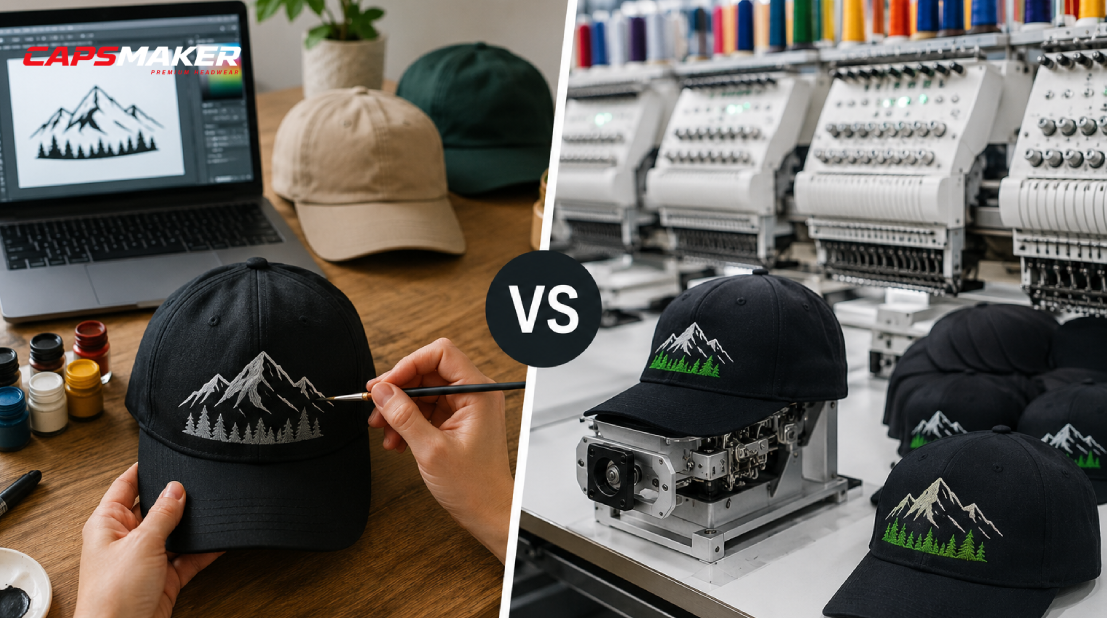
The 5-a-side group chat starts with one innocent message: “Should we get 30 caps for the league?” Ten minutes later, someone is Googling how to make custom hats, someone else is watching embroidery machine tutorials, and the “creative one” is convinced a £20 iron-on patch kit can save the day.
Then reality turns up. Heat presses. Hat hoops. Vector files. Stitch counts. Blank cap suppliers. Vinyl that peels if you look at it funny.
So the real question is not just how to make custom hats. It is whether you should make them yourself at all, or let a professional hats maker handle the messy bits. This guide gives you the honest version, especially if you are in the UK and need team custom caps, branded baseball hats, military hats, or proper custom-made hats that do not look like a school project.
Understanding Your Options (The Two Paths to a Custom Hat)
There are three realistic routes.
DIY means you buy blank caps, buy or borrow the tools, and apply the design yourself. It is fun for gifts, tiny batches, and experiments.
Professional production means you send the design brief, choose the cap style, approve the proof, and a manufacturer handles the rest. Custom Hats Maker positions its custom hats for branding, merchandise, team use, events, and promotional campaigns, which is exactly the lane where consistency matters.
The third option is the hybrid. Buy blanks yourself, then send them to a local embroiderer or printer. It is better than full DIY, but less controlled than full custom manufacturing.
The DIY Route (How to Make Custom Hats at Home)
Step 1 — Choose Your Blank Cap
Start with the blank. Get that wrong and the whole job fights you.
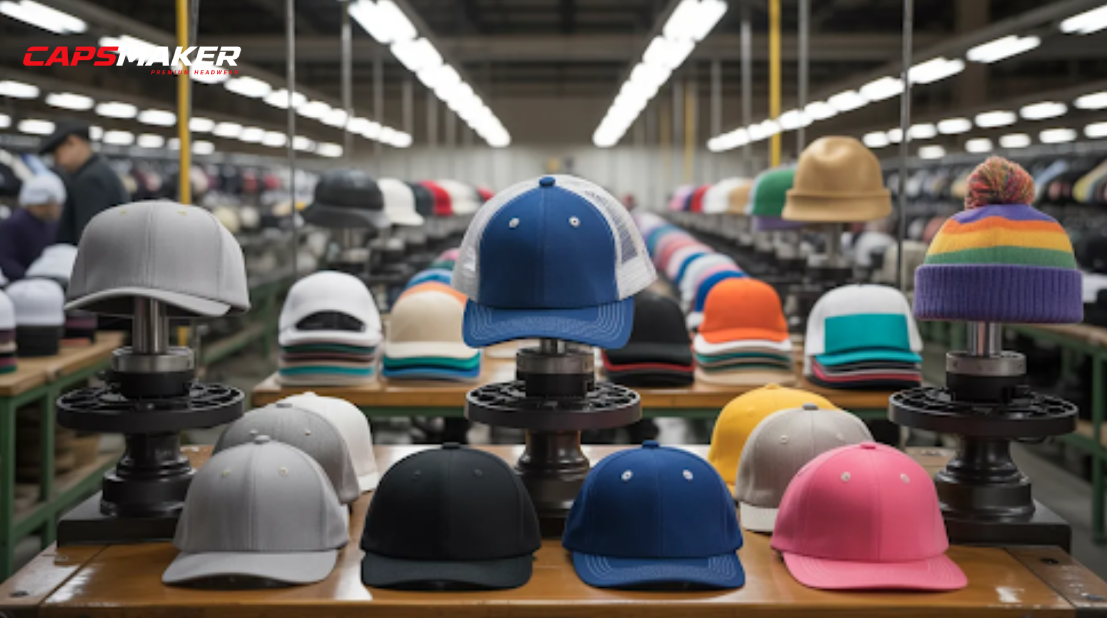
In the UK, common blank cap names include Beechfield, Flexfit/Yupoong, and Result Headwear. You will see baseball, snapback, trucker, bucket, and beanie blanks everywhere. For embroidery, choose a structured front panel. For printing custom hats, smoother panels are easier. For sports caps, breathable fabric and closure type matter more than a trendy shade.
Not sure whether your team needs a curved baseball style or a structured snapback? Read Baseball Cap vs Snapback: What’s the Difference? before ordering blanks.
For classic team and club orders, custom baseball caps are usually the safe starting point because they work for sports teams, staff uniforms, trade shows, giveaways, and everyday branded use. Custom Hats Maker notes that baseball hats can be fitted, adjustable, vintage, premium, or plain branding styles.
Step 2 — Pick Your DIY Customisation Method
Heat Transfer Vinyl is the easiest beginner route. You need a Cricut or Silhouette-style cutter, HTV, and a heat press or iron. It works for simple text, small logos, and batches of 1 to 10 caps. Hobby setup usually lands around £150 to £400, sometimes more. UK suppliers sell Siser and other HTV products for garment personalisation, with Siser products widely stocked by craft and vinyl retailers.
Hand embroidery is slower but more personal. You need a hoop, needle, thread, and stabiliser. It is good for one-off gifts, not 30 club caps. Expect one to four hours per cap if you want it to look clean.
Iron-on patches are quick. Order patches, place them, press them. Nice for casual event caps. But stitch the patch down if you want it to survive real wear.
Screen printing can work on flat-front truckers and snapbacks, but it is messy. You need a mesh screen, emulsion, ink, and a squeegee. This is not beginner-friendly unless you enjoy chaos with your tea.
Step 3 — Tools and Equipment You’ll Need
| Method | Equipment | Approx. UK Cost |
| HTV | Vinyl cutter + heat press | £150–£600 |
| Hand embroidery | Hoop, needles, stabiliser, thread | £20–£50 |
| Machine embroidery | Home embroidery machine + cap hoop | £300–£1,500 |
| Screen printing | Screen, ink, squeegee, emulsion | £80–£200 |
| Iron-on patch | Iron or heat press | £15–£150 |
Cap heat presses sold in the UK commonly appear from roughly £100 upward, while home embroidery machines can range from a few hundred pounds to well over £1,000 depending on model and condition.
Step 4 — Common DIY Mistakes to Avoid
DIY fails are not glamorous. They are usually very preventable.
People skip stabiliser and wonder why embroidery puckers. They use a flat hoop instead of a hat jig. They press polyester too hot and damage the fibres. They use low-res artwork and get blurry prints. They skip the test cap and ruin 20 blanks in one evening.
If you want bold logos on mesh-backed promo caps, custom trucker caps are better handled professionally because the structured front and mesh back need the right decoration method. Caps Maker describes trucker hats as useful for outdoor promotions, retail drops, event merch, and work crews.
The Professional Route (How Custom Hats Are Made by Manufacturers)
Stage 1 — Design Briefing & Artwork Submission
A professional order starts with a proper brief. Send AI, EPS, SVG, or a high-resolution PNG at 300 DPI. Add Pantone references if colour matching matters. Tell the supplier where the artwork goes: front, side, back, under-brim, or patch.
This is where custom hats design gets serious. A good manufacturer will tell you if tiny text needs simplifying or if embroidery should become a woven patch instead.
Stage 2 — Digitisation for Embroidery Orders
For embroidery, your logo becomes stitch data. That is digitisation. UK digitising providers commonly describe this as the process that converts artwork into embroidery-ready machine files, with pricing often affected by complexity and stitch count.
If you want sharp logos, team crests, or business caps, custom embroidered caps are usually the professional move. Bad digitisation makes even well-made hats look cheap.
Stage 3 — Prototype / Sampling
Do not skip the sample. Seriously.
A physical sample lets you check logo size, placement, thread colour, cap fit, crown shape, and overall vibe. If you are ordering custom fitted caps, sampling matters even more because sizing mistakes are harder to fix after production.
Stage 4 — Bulk Production
Once approved, production starts. Industrial embroidery machines can run several heads at once, which is why professional custom hats online orders scale better than DIY. A batch of 100 caps is not “100 separate craft projects.” It is a controlled production run.
For cadet groups, security teams, themed clubs, or forces-inspired branding, custom military hats make sense when structure and uniformity matter.
Stage 5 — Finishing & Delivery
Finishing includes trimming threads, pressing, final inspection, packaging, and delivery. UK-based support also helps avoid slow back-and-forth if something needs fixing.
DIY vs Professional (The Honest Comparison)
|
Factor | DIY | Professional |
| Cost per hat, 1–5 units | £8–£25 |
£18–£40 |
|
Cost per hat, 25–50 units | £12–£20 | £8–£18 |
| Cost per hat, 100+ units | £10–£18 |
£5–£12 |
|
Setup cost | £150–£1,500 | £20–£50 digitisation |
| Quality | Skill-dependent |
Consistent |
|
Time per hat | 30 mins–4 hours | Outsourced |
| Durability | Moderate to good |
Excellent |
|
Design complexity | Limited | Much wider |
| Colour accuracy | Approximate |
Pantone-matched |
|
Scalability | Very limited | Built for volume |
| Best for |
If you only need one funny cap for a stag do, DIY is fine. If you need team custom caps that represent a club, brand, or business, professional production wins.
Who Should DIY and Who Should Go Professional?
DIY makes sense if you need 1 to 5 caps, like crafting, have time to learn, and do not need perfect consistency.You can use this to try out a Make a Custom Hat idea before you actually spend a lot of money on it.
If you need more than 10 hats or you want the logos to look really good or you have a deadline to meet or you care about how long the hats will last then you should go with a professional service.
This is what sports teams and gyms and local businesses and military-style groups and university societies and people who organise events usually do.
There is also a way to do it: you can buy plain hats and then find someone local to decorate them for you.
This way can be cheaper than making the hats from scratch. The quality of the hats still depends on the plain hats you buy and the person who decorates them.
If you want to make streetwear-style hats or you want your team logo to really stand out then custom snapback caps are an option because they make the artwork on the front of the hat look bigger and better.
Custom snapback caps give the artwork more presence, which is great for Make a Custom Hat ideas, like that.
Cost Breakdown (What Does Each Route Actually Cost in the UK?)
A DIY setup for 25 caps might look like this:
Blank caps: 25 × £4 = £100
Vinyl cutter: about £200
Heat press: about £150
HTV materials: about £30
Total: around £480 setup, plus labour and failed attempts.
A professional 25-cap embroidered order might look like this:
Digitisation fee: around £30
25 custom embroidered caps: roughly £280–£375
Total: around £310–£405, with no equipment, no learning curve, and no ruined kitchen table.
Verdict? For anything above 10 to 15 caps, professional ordering is usually cheaper per usable cap.
Sustainability (Does DIY or Professional Have a Smaller Footprint?)
DIY can reduce waste if you make only what you need. The problem is failed caps, misapplied vinyl, and test prints.
Professional production is more efficient per unit, especially at volume. Better suppliers can also offer cotton-poly blends, breathable builds, recycled polyester, and water-based ink options. CapsMaker UK states that its custom caps use cotton/polyester blends, breathable construction, premium materials, and designs built for branding across UK teams and businesses.
If fit and wearability matter, this guide on the Winter Baseball Cap Buying Guide: Key Things to Know is useful for choosing fabrics that people will actually keep wearing.
Why CapsMaker UK Is the Smarter Professional Choice
Here is the simple bit. If you are a UK buyer searching for a custom hats maker UK, you probably do not want a new hobby. You want finished caps that turn up clean, consistent, and ready to hand out.
CapsMaker UK lists custom embroidered, trucker, fitted, snapback, sports, golf, logo, flat, cycling, and custom baseball caps, with materials built for comfort, branding, and everyday wear. That range helps whether you need sports caps, corporate merch, team caps, or custom-made hats for a launch.
A professional supplier gives design support, embroidery and print options, sampling, and bulk handling. DIY gives you a learning curve and a prayer.
FAQs
Can I make custom hats at home?
Yes. You can personalise caps at home with HTV, iron-on patches, hand embroidery, or simple printing. It works best for tiny batches, gifts, and experiments. It is not ideal for logo-heavy sports caps or professional team orders.
How much does it cost to make a custom hat?
DIY can cost £8–£25 per hat once you own the tools, but setup can run from £150 to £1,500. Professional batches often become cheaper per unit once you order more than 10 caps.
What is the best method to customise a hat?
Embroidery is usually the most durable and professional-looking method for logos, team names, and brand marks. HTV works for simple text. Screen printing suits bold flat graphics on structured panels.
What equipment do I need to make custom hats?
For HTV, you need a vinyl cutter and heat press. For embroidery, you need an embroidery machine, cap hoop, stabiliser, and thread. For patches, a household iron can work, but stitching gives a stronger finish.
How long does it take to make a custom hat professionally?
Most bulk orders take around 4–5 weeks after sample approval. Sampling can add 1–2 weeks, so order early if you have a league, launch, or event deadline.
Is it cheaper to DIY custom hats or order professionally?
For 1–5 hats, DIY can be cheaper if you already have equipment. For 10+ hats, professional ordering usually gives better value because the quality is higher and you avoid setup costs and wasted blanks.
What files do I need to order custom caps professionally?
Vector files like AI, EPS, or SVG are best. A high-resolution PNG at 300 DPI can also work. Add Pantone colours and clear placement notes if you want accurate custom hats design.
DIY Is a Hobby. Professional Is a Brand Decision.
DIY custom hats are fun when the stakes are low. One gift cap? Go for it. A tiny test batch? Cool. A weekend craft project? Love that for you.
But if the hats are for a club, league, team, brand, campaign, or business, the cap becomes part of your image. Peeling vinyl, wonky stitching, and bad placement do not say “premium.” They say “we left this too late.”
For anyone serious about quality, team pride, or brand presentation, professional custom hats are the smarter move. Get the fit right, get the artwork right, and make caps people actually want to wear.
Ready to price it properly? Visit Caps Maker UK and request a free, no-obligation quote today.
